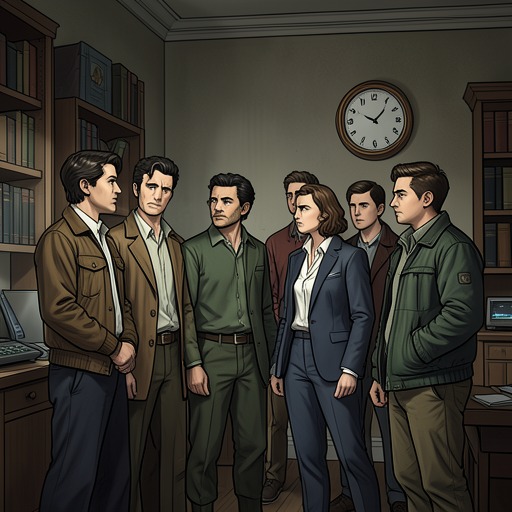
Ronald Haymes
A Murder Is AnnouncedRonald Haymes, an Army deserter and the estranged husband of Phillipa Haymes, remains absent from the action until a late police report gives his story a sharp reversal. The man who had disappeared from his family is identified after his death as the stranger who rescued a child from a lorry and was struck down himself. His final act does not erase his desertion, but it changes the meaning of his absence: it rules him out of the Little Paddocks hold-up and gives his widow and son grounds not to be ashamed of him.
Identity and Background
The evidence identifies Haymes as an ex-captain in the South Loamshires who deserted from the Army. His wife, Phillipa, has a young son, Harry, and is living with the consequences of Haymes’s disappearance without knowing where he is or what has become of him. The record offers no account of why he deserted, so his departure remains a fact with an acknowledged but unexplained past rather than a fully narrated motive.
Haymes is not initially present as a character in the household scenes. When Miss Hinchcliffe asks whether a new gardener has been taken on after seeing a man near the henhouse, the reply identifies the stranger as a detective. The passing exchange places a military-looking man in the villagers’ field of suspicion, but it does not identify Haymes as that man; the later report instead establishes his whereabouts through a separate line of police inquiry.
Phillipa and the Secret of His Absence
During her interview, Phillipa states emphatically that she has not seen her husband since his desertion. The report’s investigator doubts that she is telling the truth, and a senior officer agrees with that assessment. The later explanation makes her silence understandable: she had not learned of the accident and may have believed that Haymes was involved in the hold-up. As his wife, she would naturally have kept quiet rather than expose him to suspicion.
In a private conversation, Phillipa tells her confidante that nobody in the household knows the truth—not even her son, Harry—and insists that she never wants him to know. Her account of Haymes’s fate is deliberately limited: she says he was killed in the war, which, as she puts it, is what it amounts to for them. She does not tell Harry a heroic story; she says that she simply does not discuss his father. The distinction matters. Her silence protects the child from a painful history, but it also leaves him with an incomplete understanding of the man whose absence shapes his family life.
The person speaking with Phillipa warns that concealment carries a risk. Harry should be told the truth when he is old enough to understand, because discovering it by himself could harm him; the warning specifically rejects the danger of filling the silence with an invented tale of his father dying as a hero. The exchange frames the secret not simply as a question of whether Haymes deserves blame, but as a question of what a child should be allowed to know about his father.
Identification and Death
The decisive information emerges from a police case that first seemed unrelated to the hold-up. About ten days earlier, an unidentified man had been taken to Milchester General after being run over by a lorry. He had suffered concussion and a fractured pelvis and carried no papers; nobody came forward to identify him. Before the collision, however, he had snatched a child from practically under the lorry’s wheels. He died without regaining consciousness.
The dead man is identified as Ronald Haymes, formerly a captain in the South Loamshires and a deserter from the Army. An old Chipping Cleghorn bus ticket and a reasonable amount of money were found on him. The ticket ties the otherwise unidentified stranger to the village, while the absence of identification had initially left his connection to Phillipa and Harry unknown. The report supplies no further explanation for his journey or for the money he carried.
Reversal and Narrative Significance
The dates settle the question of whether Haymes could have taken part in the staged hold-up at Little Paddocks. He was admitted to Milchester General on the 28th; the hold-up occurred on the 29th. The police conclude that this rules him out. Phillipa, unaware of the accident, may have feared that her missing husband was implicated, and that fear helps explain why she did not correct the impression that she had not seen him.
Haymes’s rescue of the child complicates the judgment attached to desertion. The senior officer calls the act plucky and distinguishes it from the cowardice that might otherwise be assumed of a deserter. He also says that, for a man who had blotted his copybook, it was a good death. The language does not absolve Haymes or explain his earlier choice; it places that failure beside a final deed of courage, allowing both facts to remain true.
The discovery brings relief to Phillipa and to Harry’s prospects as well as resolving a police suspicion. The inspector is glad for their sake, and the senior officer concludes that the boy need not be too ashamed of his father and that Phillipa will be able to marry again. Haymes’s role is therefore brief but consequential: his death closes the uncertainty surrounding his disappearance, separates him from the Little Paddocks crime, and revises the family’s inheritance of shame without pretending that his past has disappeared.